
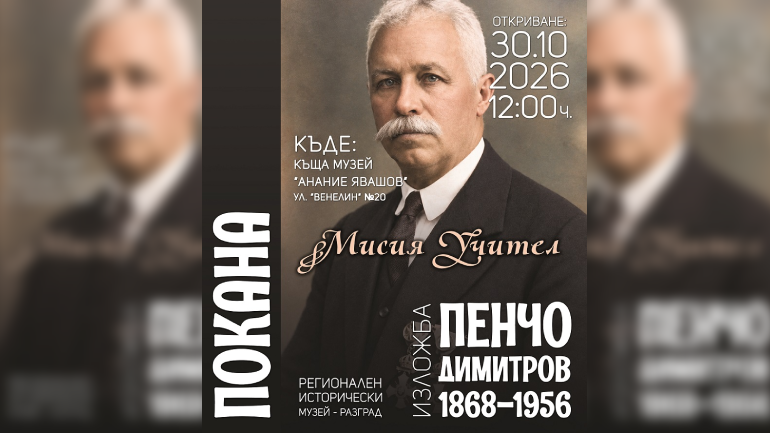
On October 30, Razgrad will mark the Day of the National Enlighteners. To mark the occasion, the Regional History Museum will present an exhibition titled “The Mission of a Teacher: Pencho Dimitrov (1868–1956)” at the Ananie Yavashov House-Museum. The exhibition is curated by Prof. Rositsa Angelova PhD, Head of the Department of Modern and Contemporary History at the institution. Through this exhibition, the prominent Bulgarian enlightener Pencho Dimitrov returns to his roots in Razgrad.
This exhibition is a unique cultural event; it brings to life—for contemporary generations—the life and work of an exceptional figure in Bulgarian education, providing the public in Razgrad with essential, historically accurate information. The exhibition is the result of years of diligent research by Prof. Rositsa Angelova PhD, who uncovered, systematized, and documented facts regarding the life and achievements of Pencho Dimitrov within the realm of Bulgarian education. As part of her scholarly work, in 2024, Prof. Angelova PhD prepared a paper titled “Contributions from Razgrad to the Educational Paradigm of Sevlievo (Late 19th – Early 20th Century)” for the national academic conference “Sevlievo Through the Centuries: Historical Dimensions, Events, and Personalities,” held in Sevlievo on September 26–27, 2024. This forum marked the 70th anniversary of the founding of the Sevlievo Historical Museum and the centenary of museum activities in the city. It was at this conference that Prof. Rositsa Angelova PhD introduced the figure of the educator Pencho Dimitrov (1868–1956) to the public for the first time.
After becoming acquainted with Prof. Angelova’s scholarly article about the national enlightener, the descendants of Pencho Dimitrov reached out to the author, and a productive relationship was established.
Data presented in a scholarly article by Prof. Angelova indicate that Pencho Dimitrov—a native of the village of Golyam Izvor in the Razgrad region—was a prominent figure in the field of Bulgarian education. Born into a poor family and orphaned at a young age, he became the first person from his village to obtain a university degree. He went on to serve as the principal of several schools—located in Sevlievo, Gabrovo, Lovech, and Tarnovo—that were considered prestigious at the time and offered the highest quality education available. His life serves as a testament to how, driven solely by a thirst for knowledge and sheer perseverance, an impoverished Bulgarian could succeed in becoming a university graduate and a leading educator. In this regard, he stands as an inspiring example—not only for teachers but also for all students from the Razgrad region who harbor dreams for the future.
He was a student in Sava Dobroplodni’s pedagogical course in Razgrad, attending as a scholarship recipient—a status granted to him as an orphan. He was subsequently assigned to the Gabrovo Boys’ Gymnasium, from which he graduated in 1888; he then went on to study history within the Department of History and Philology at the Higher School. Upon graduating in 1892—as part of the institution’s second graduating class—he became a teacher at the District Five-Grade Boys’ School in Sevlievo. At his own request, he was transferred in 1894 to the Gabrovo Gymnasium, where he eventually became a permanent faculty member. He taught history, geography, and the Bulgarian language. It is from this period that his surviving personal diary dates—a document that offers significant insight into the character of this national enlightener. He held his profession in high regard and embraced his new, greater responsibilities. The diary reveals the rare pedagogical tact with which he approached challenging students and their parents. It is abundantly clear from these personal entries that Pencho Dimitrov was an educator by vocation, not merely by obligation.
In 1904, he became the director of the Sevlievo school; from 1908, he served as director of the girls’ high school in Lovech; and in 1916, he took on the role of director of the girls’ high school in Tarnovo, a position he held until 1920. During the Balkan War, he demonstrated his humanitarian spirit at a critical juncture when the school building was requisitioned. Subsequently, he also served as the director of the boys’ high school in Gabrovo. The National Museum of Education in Gabrovo preserves a photograph from this period showing Pencho Dimitrov with his colleagues from the Aprilov High School. Upon his retirement, acting as a true “enlightener” (a figure dedicated to the cultural and intellectual advancement of the nation), he left his students with this parting message: “Willpower and courage! Knowledge and science!”
Pencho Dimitrov dedicated 36 years to the Bulgarian educational cause, 24 of which he served as a principal. His tenure as principal coincided with a challenging period for Bulgarian education, a time marked by ongoing transformation—frequent structural changes within schools and the introduction of new requirements. Yet, it was precisely this complex period that highlighted Pencho Dimitrov’s leadership qualities—his resourcefulness, ability to work with people, and adaptability—which led to his selection as principal of these educational institutions.
In the true spirit of an enlightener or cultural awakener, Pencho Dimitrov was active not only in his professional field but also in public life; he initiated the renaming of his native village, Kara Arnaut, to Golyam Izvor. He is also one of the authors of the local history study “Golyam Izvor: Historical Past, Geographical and Ethnographic Description, and Cultural and Economic Developments”, published in 1946.
The figure and achievements of this cultural enlightener will be presented at the exhibition through 16 posters, as well as items from his family archive, books from his personal library, and periodicals. The exhibition also features a number of photographs provided by historical museums in the cities where he worked.
The exhibition will feature a manuscript by Pencho Dimitrov, in which he recorded the criteria that a teacher must meet. This document will be on display in its original form. Museums in the towns where Pencho Dimitrov worked provided significant assistance in the preparation of the exhibition. Notably, some of his authentic personal belongings have been preserved: his desk is held at the Regional History Museum in Gabrovo, while his walking stick is kept at the “Etar” Regional Open-Air Ethnographic Museum.
The museum in Lovech has already extended an invitation to host the exhibition. It will be a traveling exhibition, which will help promote Razgrad’s cultural heritage in other cities as well. The exhibition was designed by Mihail Marinov.
Pencho Dimitrov’s relatives currently reside in Razgrad, Golyam Izvor, and Isperih. The Regional History Museum invites them not only to visit the exhibition but also to donate or provide the museum with any family archives related to Pencho Dimitrov, should they possess such materials. This would help to further flesh out the portrait of this cultural figure—a man who left a lasting mark on the Bulgarian educational movement.
The Regional History Museum invites everyone to attend the opening of the exhibition on October 30 at 12:00 PM.

