
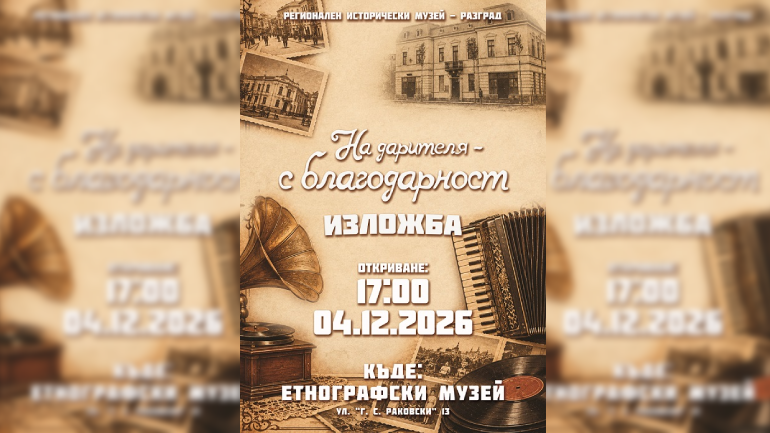
On December 4, the Regional History Museum will present the exhibition “With Gratitude to the Donor” at the Ethnographic Museum in Razgrad. Through this exposition, the cultural institution marks Donor Day—December 6—while summarizing the results of a donation campaign launched by the Regional History Museum of Razgrad two years ago.
The initiative was launched and developed under the leadership of museum director Tanya Todorova, establishing a living connection between the public and the museum. During this period, the campaign “With Gratitude to the Donor” proved significant—not only by enriching the museum’s collections in terms of both quantity and quality, but also by promoting cultural heritage, stimulating research interest in the recent and more distant past of the Razgrad region, and fostering a sense of belonging to local history. In this way, every donor plays a part in preserving historical memory.
In response to the museum’s kind invitation, the donors will attend the opening in the exhibition hall, where they will be presented with letters of appreciation. Guests will also be treated to a pre-New Year musical greeting—a performance by a soloist from the Kapanski Ensemble.
On the display panels, visitors will see items and objects donated to the Regional History Museum in Razgrad over the course of a two-year donation campaign. A key highlight is the collection of ethnographic donations. Among these are pieces from master embroiderer Detelina Dacheva, including a complete Hartsoy festive folk costume—an outfit that had been preserved in a family chest for a century. Also of Hartsoy origin is a women’s folk costume donated by Margarita Hristakieva Stoycheva, which was part of the dowry of her grandmother, Bona, from the village of Tetovo. Representatives of the Kapantsi and Balkandzhii ethnographic groups—Radka Raycheva, Neli Ivanova, and Ivanka Zhorova—also contributed to the campaign. Thus, the exhibition showcases the regional distinctiveness of traditional clothing and textiles.
A significant portion of the donations featured in the exhibition—including documents, orders, and medals—reflects the socio-political development of the region from the 20th century to the present day. The items donated by Mitko Hanchev preserve for future generations the likenesses of figures from both national and local history, such as Simeon Saxe-Coburg-Gotha, Zhelyu Zhelev, Venelin Uzunov, Petar Stoyanov, and Gyuner Tahir. In 2024, the Regional Historical Museum in Razgrad received a donation from Ofeliya Zaharieva, comprising documents, reports, and photographs from the personal archive of her husband, Simeon Zahariev. Zahariev served for many years as chairman of the Regional Chamber of Commerce, Industry, and Agriculture; he was also a municipal councilor and a prominent public figure who left a lasting and indelible mark on the region’s economic development during the second half of the 20th century, introducing numerous innovations to the economic life of Razgrad. Equally noteworthy is the generous contribution made by Milena Terzieva, daughter of Marinka Angelova—the first and, to date, only woman to serve as mayor of Razgrad. She donated her mother’s state decorations—orders and medals—as well as various badges, plaques, and insignia (totaling 41 items), all of which had been awarded to Angelova in recognition of her active public service.
As part of a donation campaign, the collection of the Regional History Museum in Razgrad has been enriched with valuable artifacts dating from the period immediately preceding and during the Second World War (1939–1945). These include a black-and-white photograph of the non-commissioned officer candidates of the Eighth Cavalry Regiment, donated by Krasen Ganchev, and a map of the Kingdom of Bulgaria from the early 1940s—which belonged to Yordan Rashev, a long-serving teacher, school principal, and Chairman of the Municipal Council in Razgrad—donated by his descendant, Slaveyko Rashev. Also featured in the exhibition is an extensive collection of orders, medals, honorary badges, and photographs belonging to Todor Nikolov Todorov, who served in both phases of Bulgaria’s Patriotic War and was a close associate of General Vladimir Stoychev, commander of the First Bulgarian Army.
The exhibition serves as a gesture toward donors and marks the final stage of the campaign “With Gratitude to the Donor”. It acts as an appeal to all citizens who possess historical evidence regarding the development of Razgrad over the years to donate these items to the museum, ensuring they are preserved for future generations as part of the region’s cultural heritage.
The exhibition will open at 5:00 PM on December 4.

